
Clutch Disc
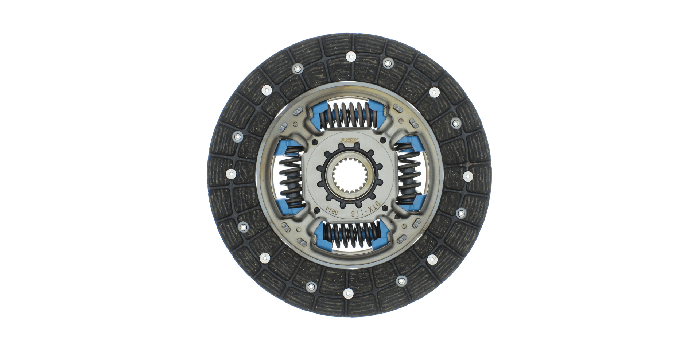
The clutch disc consists of a metal disc covered with a frictional facing similar to brake shoes or pads. The lining is made of a woven or moulded non-organic material that also contains particles of soft metal such as aluminium or brass. This improves the strength of the lining and a series of radial grooves in the lining's face enhances the grip between the flywheel and the disc. A splined hub in the centre of the disc mates with the transmission's input shaft, thereby providing a direct mechanical coupling between the two. A group of torsional springs located between the clutch hub and lining dampens driveline shock and vibration. The clutch disc is located between the flywheel and pressure plate.
Purpose
The clutch disc transmits engine torque directly to the input shaft of the transmission. The clutch disc, when coupled with the pressure plate and flywheel, makes and breaks the flow of power from the engine to the transmission.
Maintenance Tips/Suggestions
Since pressure to the clutch disc is applied and released continuously throughout the course of normal driving, the clutch disc lining will wear over time making it a normal wear item. Clutch chatter is a common symptom that may indicate a worn clutch, but this symptom could also be caused by oil leaking from the engine onto the clutch assembly, a poor flywheel surface, damaged pressure plate release levers, a sprung clutch disc hub and improper alignment between the engine and transmission.
Another common clutch problem is clutch slippage. This can be caused by a variety of factors such as a damaged pressure plate, worn, binding or misadjusted linkage, incorrect clutch components, and even normal wear.
A dragging clutch is the least common symptom and is just the opposite of slippage. Drag occurs when the clutch doesn't release at all, or releases only partially. Clutch drag is usually caused by a worn, binding or misadjusted clutch linkage. Drag can also be caused by air in the hydraulic clutch linkage, damaged pressure plate fingers, and binding of the clutch disc on the input shaft. To get to the heart of your car’s clutch problem, have a professional technician road test your car to confirm the symptoms you’re experiencing. It is the best first step of a proper diagnosis.
Happy Clients

This hasn't been the easiest journey but Jerry made it seamless. The first engine did not work for my daughter's car and we had to get a second engine. Jerry was with us every step of the way throughout the warranty process. The second engine worked perfectly, our daughter is in her own car and all is well with the world. I couldn't imagine going through this, 900 miles away from the company, with someone dodging my calls or avoiding me. Jerry stayed in constant contact and answered every question with confidence.
Global Automotive Parts: Your Partner in Automotive Excellence. I have been a loyal customer of Global Automotive Parts for years and I can confidently say that they are the best in the business. They offer a huge range of high-quality parts for all makes and models, and their team is always available to provide expert advice and guidance. Whether you're in need of a replacement engine, transmission, or any other part, you'll find that Global Automotive Parts is always very helpful.
Global Automotive Parts Provides Outstanding Customer Service. I recently had the pleasure of working with the team at Global Automotive Parts and was impressed with their level of customer service. They were incredibly helpful in guiding me through the process of finding the right engine for my car, and went above and beyond to ensure that I received the best possible service. The engine itself was in excellent condition and works perfectly. I highly recommend Global Automotive Parts for anyone in need of outstanding customer service and high-quality parts.
Global Automotive Parts: The Best Place for Used Engines. I recently purchased a used engine from Global Automotive Parts and I am extremely satisfied with the product and service I received. The team, including Jerry, Joe, Joey, Kevin, Trevor, Markwood, Ethan, Tina, Nora, Ben, and Danny, was incredibly helpful in guiding me through the process and ensuring that I received the right engine for my car. The engine itself was in great condition and works perfectly. I highly recommend Global Automotive Parts for anyone in need of reliable used engines.
Global Automotive Parts: The One-Stop Shop for Used Parts. If you're in need of reliable used parts, look no further than Global Automotive Parts. They offer a huge range of parts for all makes and models, including engines, transmissions, transfer cases, and more. The team is incredibly knowledgeable and helpful in ensuring that you receive the right part for your car. I highly recommend Global Automotive Parts for anyone in need of reliable used parts.
Global Automotive Parts: Your Source for Crate Engines. I recently purchased a crate engine from Global Automotive Parts and I couldn't be happier with the product and service I received. The team was incredibly helpful in guiding me through the process and ensuring that I received the right engine for my car. The engine itself was of exceptional quality and works perfectly. I highly recommend Global Automotive Parts for anyone in need of expertly crafted crate engines.
Rebecca provided an exceptional customer service experience. Her brilliant performance in customer service provided me a great satisfaction and I must say, Global Automotive Parts is a great company and they will always deliver. I am confident in their service. I salute Global Automotive Parts Team.
Good service in finding a 5.9 liter motor and arrange shipping. Received motor and installed. You only get the basic motor components, no power steering pump, no alternator, turbo. So make sure you secure all the components you need to install the motor. 3 year warranty is a nice plus also. I would use your service again. Thanks, Calvin.
Hi my name is Kim myself &my husband ordered parts for both our cars from Global Automotive Parts & it was like magic ms Nora River & the staff of this company was excellent in finding the parts we needed I would recommend this company as the Global Automotive Parts for all your needs. Customer service was excellent. Thank you Ms. Nora & Anna & team, you the best👍😇👍
If you're in the market for a car engine, look no further than Global Automotive Parts. The selection and quality of their engines are top-notch, and their customer service is second to none.
Joe and his crew was effective with letting me know about my part I bought and when will it be delivered. Appreciate their hard work. Check them out if needed
Nora and Austin were extremely helpful in finding exactly what I needed for my car. Nora was very professional and persistent in making sure that I was informed of the process.
Fast, courteous service, wouldn't hesitate to purchase them again Thanks you Kevin
My engine arrived !! Got it installed ! Runs great !!! Joe & Nora got delivered to me here in Fort Worth , Texas. Jim Totten / Norm Reeves Honda